
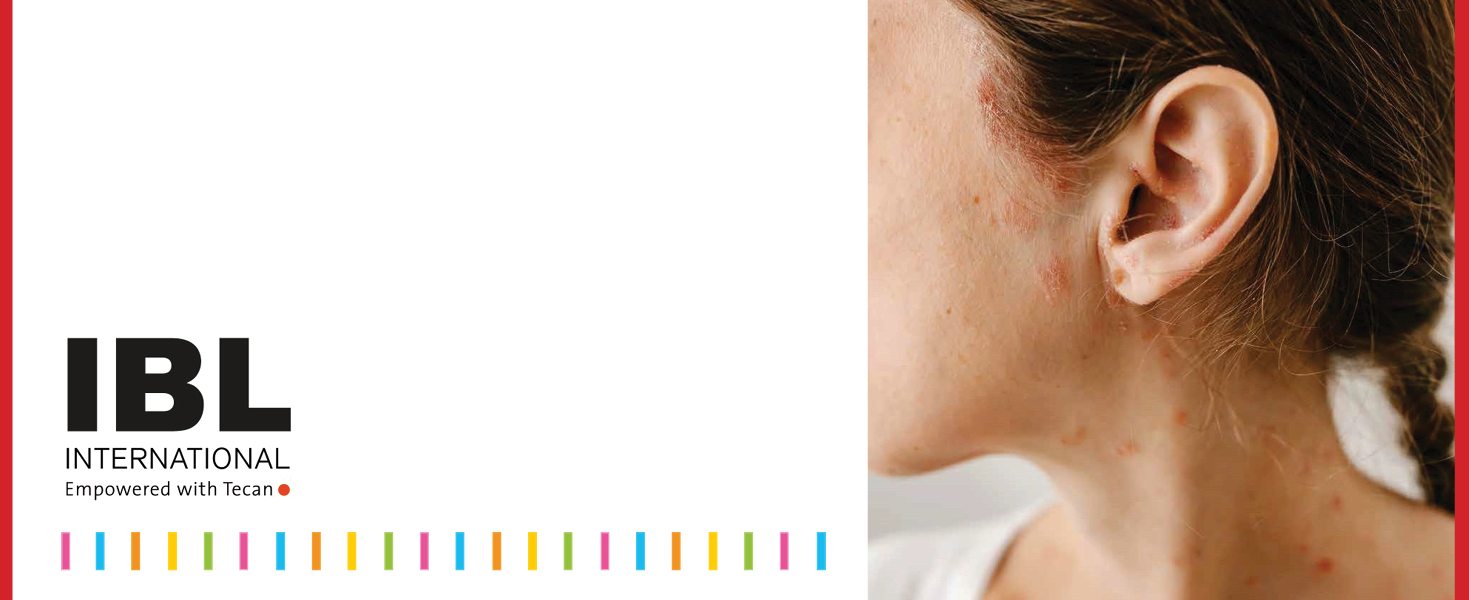
Be at the forefront of Atopic Dermatitis testing in Australia.
A valuable tool for patient stratification in atopic dermatitis; this kit utilizes an enzyme-linked immunosorbent assay (ELISA) method to quantify SCCA2 in serum. Samples are added to microtiter plate with 96-wells (solid phase) coated with anti-SCCA antibody, and after washing, a POD-conjugated anti-SCCA2 antibody is added to react, an immune complex is formed. After the unreacted POD-conjugated anti-SCCA2 antibody is removed by washing, a chromogenic substrate is added to perform the enzymatic reaction, and color develops in proportion to the amount of SCCA2 in the samples. The color development is stopped, and the color intensity is measured at 450nm.

Fig. 1: Principal of the SCCA2 ELISA
About SCCA2
SCCA (squamous cell carcinoma antigen) is a serine protease inhibitor belonging to serpin superfamily, which is a protein with a molecular weight of about 45 kDa produced mainly by epithelial cells. SCCA contains the isoforms SCCA1(SERPIN B3) and SCCA2(SERPIN B4, which are independent gene products transcribed from distinct loci, albeit with very high-amino-acid homologies of 91%.
Unlock deeper insights and improve sample management in dermatology research with the SCCA2 ELISA kit
It is known that interleukin 13 (IL-13), one of the type Th2 cytokines, plays crucial roles in allergic inflammation. SCCA2 was identified as one of the molecules whose expression is elevated when airway epithelial cells are stimulated with IL-4 and IL-13, cytokines that are central in allergic responses.¹ Serum SCCA2 levels in children with atopic dermatitis have been reported to be significantly elevated according to the severity of the disease, even when compared with existing blood tests²,³,⁴.

Fig. 2 ROC curve analyses of SCCA2 (red solid line) and TARC (black dashed line) in all and <1 year old, 2 to 6 years old, and 7 to 15 years old of control subjects and AD children
In the treatment of atopic dermatitis, it is important to select and use anti-inflammatory drugs appropriately according to their severity. Currently there are more than 30 different drug candidates in clinical phase 2 and 3 trials⁵ needing reliable objective tools such as the SCCA2 ELISA for stratification of study participants and to see possible effects.
Unlock deeper insights in dermatology research.
*Research Use Only. Not for use in diagnostic procedures.
THESE PRODUCTS ARE NOT AVAILABLE FOR PURCHASE BY THE GENERAL PUBLIC.
References:
- Yuyama N, Davies DE, Akaiwa M, et al.
Analysis of novel disease-related genes in bronchial asthma.
Cytokine. 2002;19(6):287-296.
DOI: 10.1006/cyto.2002.1972
PubMed ID: 12421571 - Ohta S, Shibata R, Nakao Y, et al.
The usefulness of combined measurements of squamous cell carcinoma antigens 1 and 2 in diagnosing atopic dermatitis.
Ann Clin Biochem. 2012;49(Pt 3):277-284.
DOI: 10.1258/acb.2011.011065
PubMed ID: 22402915 - Nagao M, Inagaki S, Kawano T, et al.
SCCA2 is a reliable biomarker for evaluating pediatric atopic dermatitis.
J Allergy Clin Immunol. 2018;141(5):1934-1936.e11.
DOI: 10.1016/j.jaci.2018.01.021
PubMed ID: 29421276 - Watanabe Y, Yamaguchi Y, Komitsu N, et al.
Elevation of serum squamous cell carcinoma antigen 2 in patients with psoriasis: associations with disease severity and response to the treatment.
Br J Dermatol. 2016;174(6):1327-1336.
DOI: 10.1111/bjd.14426
PubMed ID: 26822223 - Obed O, Chong AC, Su M, Ong PY.
Emerging drugs for the treatment of atopic dermatitis: a focus on phase 2 and phase 3 trials.
Expert Opin Emerg Drugs. 2024;29(3):233-249.
DOI: 10.1080/14728214.2024.2345643
PubMed ID: 38662529
Request a Quote