
THESE PRODUCTS ARE NOT AVAILABLE FOR PURCHASE BY THE GENERAL PUBLIC.
Use Zytovision FISH probes to detect gene fusion status in NTRK1/2/3 genes.
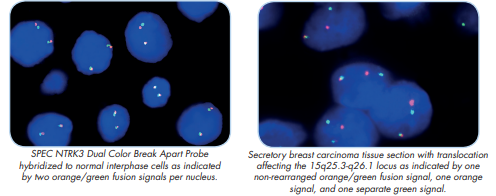
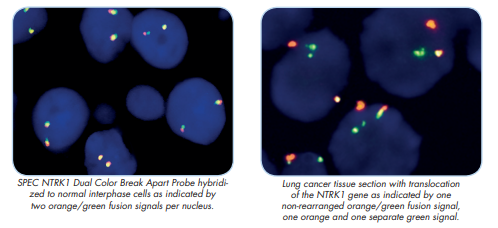
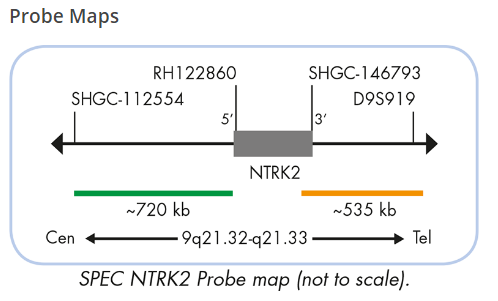
The ZytoLight Dual Color Break Apart Probes are to be used for the qualitative detection of translocations involving the human NTRK1, NTRK2, and NTRK3 genes in formalin-fixed, paraffin-embedded specimens by fluorescence in situ hybridization (FISH). The probes are intended to be used as an aid to the differential diagnosis of various cancers.
|
Item Number |
Item Description |
|
ZYZ216750 |
ZytoLight SPEC NTRK1 Dual Color Break Apart probe 0.05ml |
|
ZYZ2167200 |
ZytoLight SPEC NTRK1 Dual Color Break Apart Probe 0.2 ml |
|
ZYZ220550 |
ZytoLight SPEC NTRK2 Dual Color Break Apart probe 0.05ml |
|
ZYZ2205200 |
ZytoLight SPEC NTRK2 Dual Color Break Apart Probe 0.2ml |
|
ZYZ220650 |
ZytoLight SPEC NTRK3 Dual Color Break Apart probe 0.05ml |
|
ZYZ2206200 |
ZytoLight SPEC NTRK3 Dual Color Break Apart Probe 0.2ml |
ZytoLight® SPEC NTRK1 Dual Color Break Apart Probe

ZytoLight® SPEC NTRK2 Dual Color Break Apart Probe

ZytoLight® SPEC NTRK3 Dual Color Break Apart Probe