

Products are for professional/laboratory use only.
Alexa Fluor® 680 is a far-red-emitting dye with peak excitation at 684nm and peak emission at 702nm. Alexa Fluor® 790 is an infrared-emitting dye with peak excitation at 783nm and peak emission at 803nm.
Antibodies conjugated with far-red- and Infrared-emitting dyes are more sensitive than those with dyes emitting visible light due to low fluorescence quenching of the conjugates, high extinction coefficients of the dyes, and low background autofluorescence. The increased brightness allows for a wider range of immunofluorescence detection and imaging modalities. Far-red and Infrared dye conjugates can be used for higher sensitivity Western blots, quantitative Western blots, in-gel Western blots, microWestern arrays, in-cell Western arrays, on-cell Western arrays, tissue section imaging, small animal whole body imaging, and other techniques that require the brightest dyes.
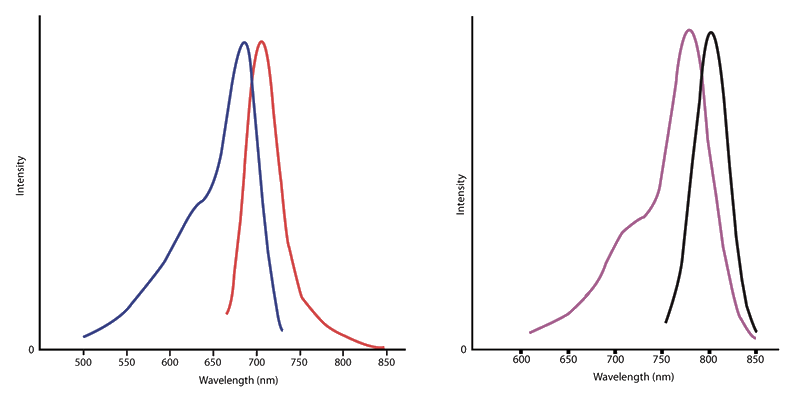
Jackson ImmunoResearch now offers the largest selection of Alexa Fluor® 680 and Alexa Fluor® 790 dyes conjugated with signal-enhancing primary antibodies, affinity-purified secondary antibodies, streptavidin, and purified IgG controls for single- and double-labeling Western blots (Figure 2) and other techniques requiring high sensitivity. The secondary antibodies are adsorbed to eliminate cross-reactions with others species and with other immunoglobulin classes for double labeling.
f
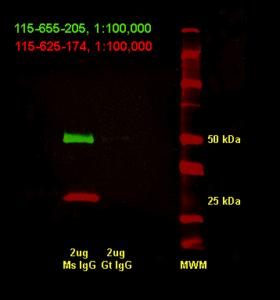 Figure 2. Double immunofluorescence staining on a Western blot using Alexa Fluor® 680 far-red dye and Alexa Fluor® 790 infrared dye. Mouse IgG and goat IgG were reduced and denatured with β-mercaptoethanol and SDS. The heavy and light chains were separated by electrophoresis in SDS-PAGE, transferred to nitrocellulose, and double labeled with a 1:100,000 dilution of Alexa Fluor® 790-goat anti-mouse IgG, Fcγ Subclass 1 specific (min X Hu, Bov, Rb Sr Prot, 115-655-205)(green) to detect heavy chains and a 1:100,000 dilution of Alex Fluor® 680-goat anti-mouse IgG, light chain specific (min X Bov, Gt, Hrs, Hu, Rb, Rat, Shp Ig, 115-625-174)(red) to detect light chains. Fluorescence was imaged in a LiCor Odyssey imager. Goat IgG was used as a background control. Note the faint bands of goat IgG heavy and light chains attesting to the extreme brightness of the dyes even at a dilution of 1:100,000.
Both dyes can be used with LiCor Odyssey imaging systems and all of the high-sensitivity techniques listed above. We recommend that the antibodies be diluted at least 1:50,000 to 1:200,000 due to the high sensitivity of the conjugates.
Click here to see Jackson’s table of Alexa Fluor® 680 and Alexa Fluor® 790 dyes conjugated to signal-enhancing primary antibodies, affinity-purified secondary antibodies, streptavidin, and purified IgG controls.
Article originally posted on Jackson ImmunoResearch Laboratories website.