
Are You Maximising Your Multiplex qPCR Potential?
- Do you have a multiplex instrument?
- Running qPCR assays regularly?
- Ready to detect up to 150 genetic targets from a single well?
Unlock the power of ultra-high multiplexing—streamline your workflow, save time, and get more data from every run.

Genomic applications
- Pathogen identification
- Gene expression
- SNP typing
- Copy number variation analysis
- miRNA analysis
Use Luminex MagPlex TAG beads to expand your genomic multiplexing capabilities
MagPlex-TAG Microspheres are are oligonucleotide-coupled polystyrene microparticles. Each one of the color-coded beads has a unique 24 base DNA sequence called an “anti-TAG” covalently coupled to its surface. These beads enable you to quickly and easily design custom bead arrays simply by adding a complementary “TAG” sequence to the primer or probes in your assay and hybridizing those TAGs to the anti-TAG sequence on the corresponding microsphere.
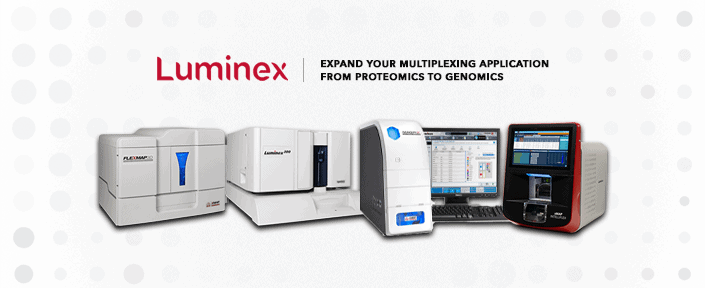
Compatible with all xMAP instruments*


See these publications for this application being used:
- Multiplex Detection of Five Canine Viral Pathogens for Dogs as Laboratory Animals by the Luminex xTAG Assay
- Added value of multiplex Luminex Gastrointestinal Pathogen Panel (xTAG® GPP) testing in the diagnosis of infectious gastroenteritis
- A method for high-throughput gene expression signature analysis
* Refer to MagPlex TAG regions to confirm which groups you can use with your instrument.
THESE PRODUCTS ARE NOT AVAILABLE FOR PURCHASE BY THE GENERAL PUBLIC.