

Invivoscribe – LymphoTrack Flex

THESE PRODUCTS ARE NOT AVAILABLE FOR PURCHASE BY THE GENERAL PUBLIC. Identifying clonality and determining the frequency of immunoglobulin (Ig) and T-cell receptor (TCR) gene rearrangements is crucial in understanding lymphoproliferative diseases.1 These gene rearrangements serve as markers for clonal lymphocyte populations, aiding in the detection of blood cancers.2,3 The introduction of next-generation sequencing (NGS) has enhanced […]
Invivoscribe – NPM1 MRD Assay now available globally

Invivoscribe’s NPM1 MRD Assay is an NGS-based, targeted, deep-sequencing assay that detects and monitors DNA sequences specific to identified mutations from the primary sample identified at diagnosis with an allelic sensitivity level of 5×10⁻⁵. This assay identifies and reports mutation variants ‘A,’ ‘B’, ‘D’, and ‘Other’ in subjects with no overt evidence of disease. In addition, the NPM1 MRD Assay can be multiplexed with the FLT3 ITD MRD Assay to improve throughput […]
TriLink – CleanCap® M6 IVT Kit, High Yield
Streamline your mRNA synthesis with TriLink’s CleanCap® IVT kits, which yield up to 1 mg per 100 µL reaction. Designed for efficiency and excellence, these kits include all components to generate high-quality mRNA using in vitro transcription (IVT) with CleanCap® co-transcriptional capping. CleanCap® M6 IVT Kit, High Yield Includes Trilink’s newest cap analog, CleanCap® M6, for those aiming for even higher […]
TriLink – saRNAs

Express more with premade and custom saRNAs Why use saRNA? This makes TriLink’s saRNAs highly attractive for the development of innovative vaccines and gene therapies. saRNAs contain alphavirus sequences including non-structural proteins (nsp1-4), allowing them to self-replicate and amplify protein expression.
TriLink – CleanCap AG (3′ OMe) CleanScript IVT Kit
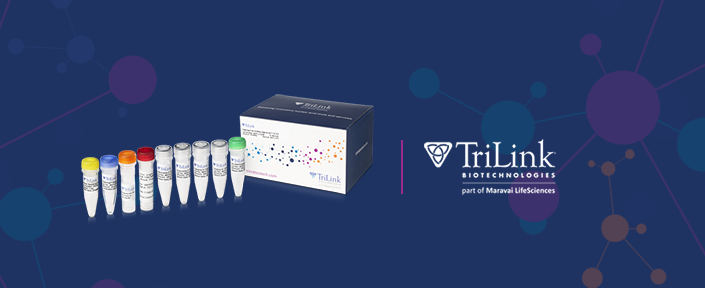
TriLink’s CleanCap® AG (3′ OMe) CleanScript™ IVT Kit provides essential components for mRNA synthesis using co-transcriptional capping by in vitro transcription (IVT). The kit components are sufficient to run 25 x 100 µL or 125 x 20 µL reactions reactions following our recommended IVT protocol with co-transcriptional capping.