Products are for professional/laboratory use only.
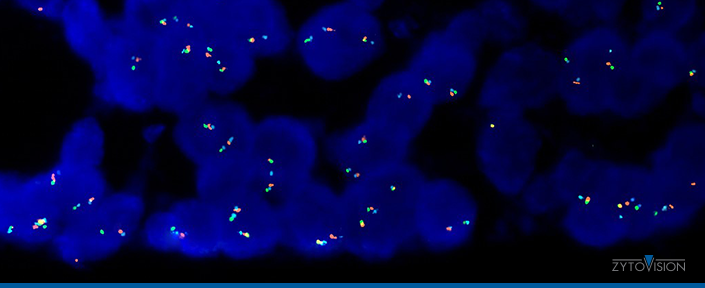
ZytoVision’s ZytoLight® products are designed for the identification of genetic aberrations eg. translocations, deletions, amplifications and chromosomal aneuploidies by Fluorescence in situ Hybridisation (FISH) in formalin-fixed, paraffin-embedded tissue sections, cell samples, blood or bone marrow smears and metaphase chromosome spreads.
Why choose ZytoLight® for FISH lung cancer diagnosis?
- Brighter signals and superior background: ZytoLight® uses directly labelled FISH probes which eliminate the need to detect the probes with fluorophore-coupled antibodies
- The unique ZytoLight® Repeat Subtraction Technique leads to advanced specificity and less background of all SPEC™ probes
- ZytoVision is the first manufacturer worldwide to introduce the uniquely designed ALK/EML4 TriCheck™ FISH probe for lung cancer diagnosis
- Available for IVD use in Australia and New Zealand; ARTG 256572
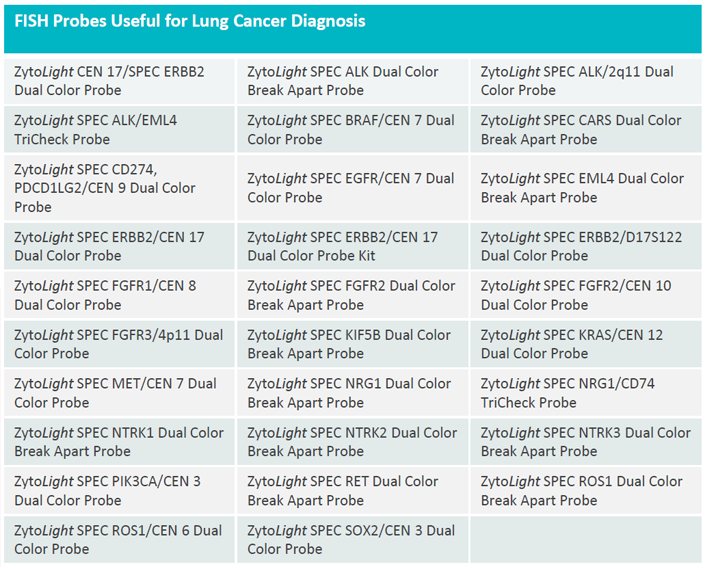
The following ZytoLight® FISH probes are useful for lung cancer diagnosis:
Please check regulatory status in your country.